A developer portfolio is the page someone opens after reading your name on a CV, a pull request or an email, to decide whether you're worth a call. It has one job: show, in under a minute, what you build and the proof that it works. Everything else is decoration.
My portfolio is two sites. halit.org is about me: who I am, where I've worked, what I write. projects.halit.org is about what I've shipped: 27 open source projects, each with its own page and docs. Here is what goes into each, and why I split them.
What a developer portfolio should include
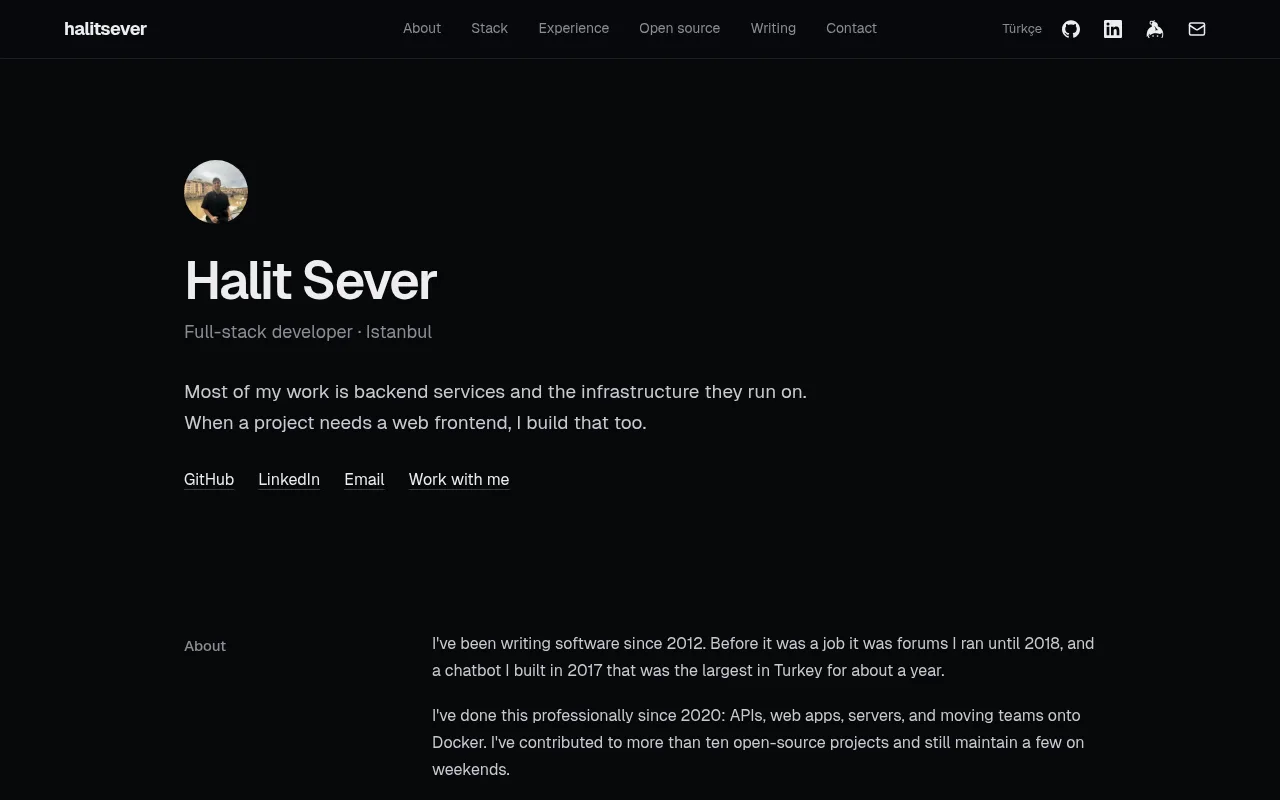
- One line that says what you do. Mine is "Full-stack developer · Istanbul". A visitor should know your role before they scroll.
- Shipped work, with links. Live products, repos, packages. Something they can open, not a screenshot of something they can't.
- Proof that people use it. Stars, downloads, store ratings, users. Numbers someone else can check.
- Experience, written as outcomes. "Moved every application onto Docker, which cut deployment time by about 60%" says more than "Docker, Kubernetes, CI/CD".
- Writing. Posts show how you think and give search engines something to find you by.
- A way to reach you. An email address in plain text. If you take freelance work, a page that says what you take on.
Part one: the personal site
The home page of halit.org is one long page with seven sections: about, stack, experience, open source, education and community, writing, and contact.
A few decisions that I'd repeat:
- Experience bullets are outcomes. Each job lists what changed because I was there: NestJS services handling over 100M requests a day under 200 ms, a real-time order-tracking dashboard in Nuxt, three junior developers mentored.
- The hire page is separate. People who want to hire someone have different questions from people who want to read about Nuxt. /hire answers theirs: what I build, how a project runs, work they can check, and an FAQ. There's a Nuxt-specific version and a Turkish one too.
- Two languages, both written natively. I live and work in Turkey, so there's a full Turkish version at /tr, written in Turkish rather than translated.
- The site is a project in its own right. It's Nuxt 3 with Nuxt Content, prerendered, deployed on Vercel on every merge, with a sitemap, structured data and an RSS feed. I wrote up the SEO setup with the real config.
Part two: the projects hub
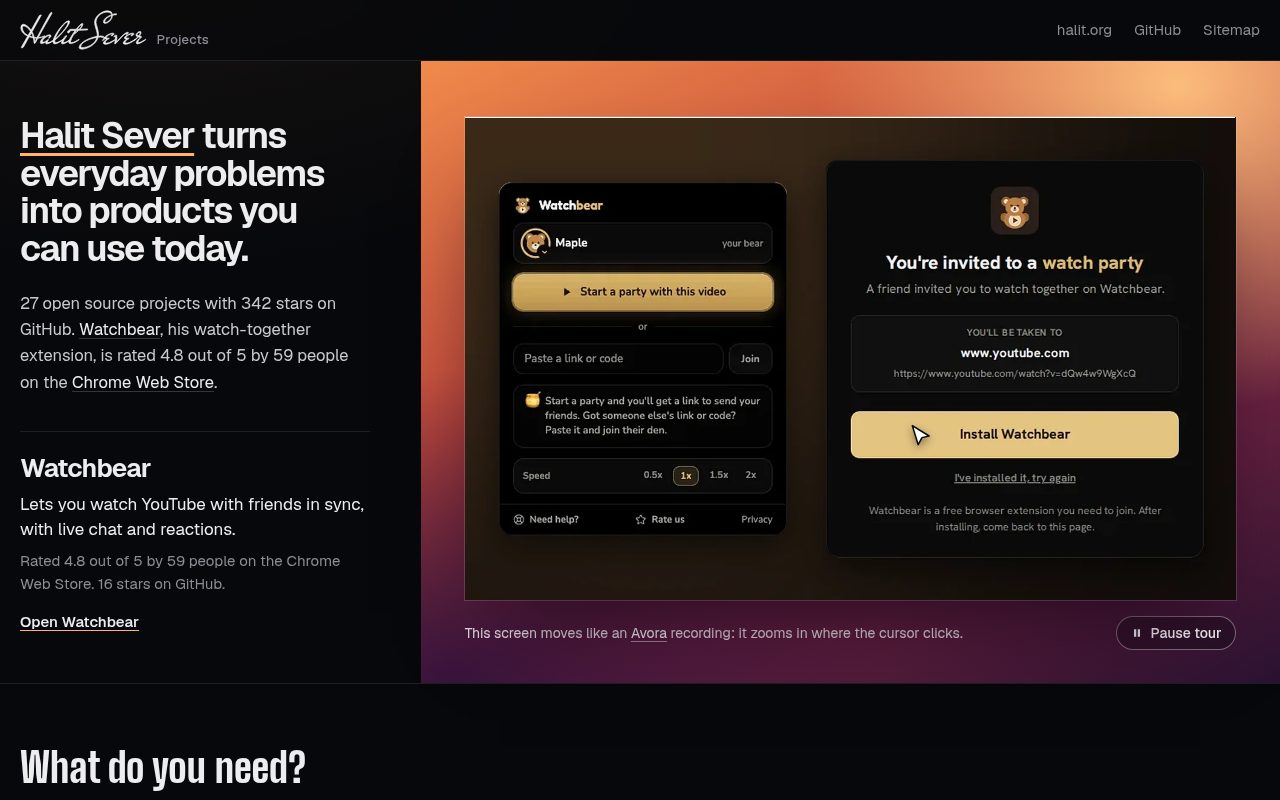
projects.halit.org exists because a list of 27 repos on a CV is noise. The hub puts them in front of people as products: the headline is "Halit Sever turns everyday problems into products you can use today", and each project is introduced by the problem it solves, not the language it's written in.
The proof I point to, all of it checkable by anyone:
- Watchbear, a watch party Chrome extension: rated 4.8 from 59 ratings on the Chrome Web Store, with 1,000 users.
- nest-cloudflare-turnstile, a NestJS captcha guard: 5,159 npm downloads in the last month.
- girici-web-proxy, a self-hosted web proxy in TypeScript and Vue, with a Docker setup to run it on your own server.
- nuxt-telegram-auth, a Nuxt login module: 1,224 npm downloads in the last month.
Most projects also have their own docs site under projects.halit.org, hosted free on GitHub Pages. Someone who wants to judge the code can read the code. Someone who wants to know whether the product works can try it.
Why split it into two sites?
Different visitors want different things. A recruiter or client wants the person: experience, location, languages, how to get in touch. Someone who found a project through search wants the product: what it does, how to install it, whether it's maintained.
One site that tries to do both ends up as a long list of repos under a bio. Two sites that link to each other let each do one job well. The personal site links to the hub, and the hub links back.
Mistakes I see in developer portfolios
- A tech stack instead of work. Twenty logos tell me what you've heard of, not what you've built.
- Tutorial projects. A to-do app from a course shows you can follow a course. Something that solves a problem you actually had shows more.
- Dead links. A portfolio whose demo is down says more than no demo at all. Prefer things that cost nothing to keep running: static sites, GitHub Pages, free tiers.
- No numbers. If people use your thing, say how many. If they don't yet, say what it does and let it be small.
- Hidden contact details. If the only way to reach you is a form at the bottom of the third page, most people won't.
Software developer portfolio examples to learn from
Look at portfolios of developers you'd like to work with, and check them against the list above: can you tell what they do in five seconds, can you open their work, can you see that someone uses it, can you reach them? Mine are halit.org and projects.halit.org, and your own GitHub profile counts too: a profile README turns it into a page of its own.
If you're hiring and this is the kind of work you need, the hire page is the place to start.
FAQ
What should a developer portfolio include?
A one-line description of what you do, shipped work with links, proof that people use it, experience written as outcomes, some writing, and a plain email address.
Is GitHub enough as a developer portfolio?
It's a good part of one. A personal site adds what GitHub can't: your story, outcomes from paid work you can't open-source, and a clear way to hire you.
Where can I host a developer portfolio for free?
GitHub Pages, Vercel and Netlify all have free tiers that are enough for a portfolio. My project docs run on GitHub Pages and my personal site on Vercel.
How many projects should a developer portfolio show?
As many as you can explain and keep working. Three finished projects with live links beat ten half-finished ones.